
Blessures de surf
Coupures de corail : comment les traiter et pourquoi l'infection est le vrai danger
16 janv. 2026 · 6 min de lecture
Les récifs coralliens sont magnifiques vus depuis le line-up. Ils se comportent comme un couteau dentelé couvert de bactéries quand vous vous échouez dessus. Si vous surfez les vagues de récif à Arugam Bay ou ailleurs le long de la côte sri-lankaise assez longtemps, vous finirez par vous couper sur le corail. La question est de savoir si vous la traiterez correctement ou si vous vous retrouverez à la clinique avec une infection grave.
Pourquoi les coupures de corail sont différentes des coupures ordinaires
Les coupures de corail ont trois choses contre elles : des fragments de corail incrustés dans la plaie, les bactéries d’un océan tropical chaud, et un apport constant de nouvelles bactéries chaque fois que vous retournez dans l’eau avant que la plaie ne soit cicatrisée. Même une petite coupure de corail peut évoluer en cellulite (infection cutanée), en abcès profond, ou dans de rares cas en quelque chose de bien pire, en un jour ou deux, si elle n’est pas correctement nettoyée.
La plus grande erreur que nous voyons, ce sont les voyageurs qui nettoient une coupure de corail à l’eau de mer, y collent un pansement, et retournent surfer le lendemain matin. L’eau de mer ne désinfecte pas la plaie — bien au contraire. Le pansement emprisonne l’humidité et les bactéries. La session de surf suivante recontamine tout.
Comment nettoyer correctement une coupure de corail
Si vous pouvez venir nous voir dans les heures qui suivent la blessure, c’est la meilleure option. Nous disposons du bon matériel, du grossissement et du sérum physiologique stérile pour le faire minutieusement. Si vous la nettoyez vous-même d’abord, voici le bon ordre :
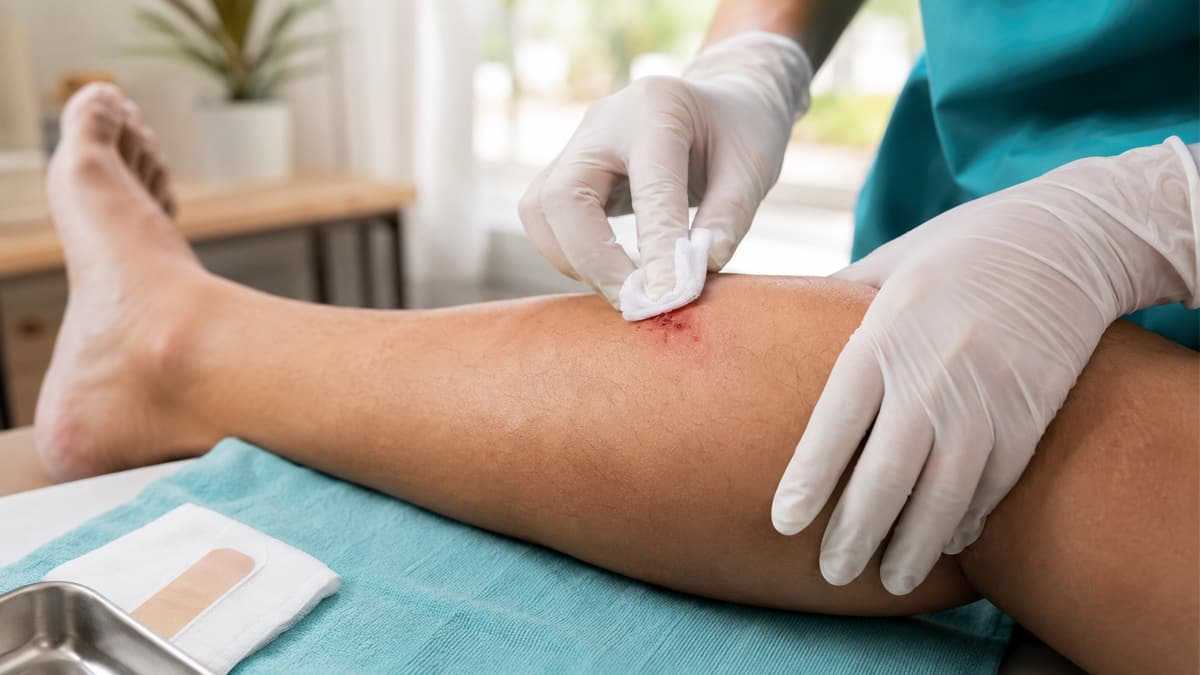
- Sortez de l’eau et arrêtez le saignement. Pression directe avec un linge propre pendant cinq à dix minutes. La plupart des coupures de corail saignent moins qu’il n’y paraît.
- Rincez abondamment à l’eau douce. Pas à l’eau de mer. Utilisez de l’eau en bouteille si aucun robinet n’est à proximité.
- Frottez l’intérieur de la plaie. C’est douloureux, mais c’est l’étape la plus importante. Utilisez un linge propre, une compresse ou une brosse à dents souple neuve. Le but est de retirer physiquement chaque parcelle de corail, de sable et de bactéries. Si vous voyez encore des bouts de corail ou de gravier à l’intérieur de la plaie après rinçage, vous n’avez pas terminé.
- Désinfectez avec un antiseptique. La povidone iodée (Betadine) est idéale. La chlorhexidine fonctionne aussi. Évitez de verser de l’alcool pur ou de l’eau oxygénée dans la plaie — ils détruisent les tissus dont vous avez besoin pour cicatriser.
- Pansez légèrement. Un pansement non adhésif, maintenu par du sparadrap, laissant passer un peu d’air. Changez-le deux fois par jour, en nettoyant et en redésinfectant à chaque fois.
- Restez hors de l’eau jusqu’à ce que la plaie soit refermée. C’est le plus difficile pour un surfeur en voyage. Mais chaque fois que vous retournez dans l’eau avec une plaie ouverte, vous la réinfectez. Prenez quelques jours de repos, ou venez nous voir pour des pansements imperméables si vous ne pouvez vraiment pas attendre.
Quand consulter un médecin
Venez nous voir si l’un de ces cas s’applique :
- La coupure est plus profonde que la couche superficielle de la peau (vous voyez de la graisse ou du muscle)
- La coupure se situe sur une articulation, le visage, les mains ou la plante des pieds
- Vous n’arrivez pas à retirer tout le corail ou le gravier
- La coupure ne cesse pas de saigner après quinze minutes de pression
- Vous n’êtes pas sûr que votre vaccin contre le tétanos soit à jour
- La plaie date de plus de six heures et n’a pas été correctement nettoyée
- Après un jour ou deux, vous remarquez une rougeur qui s’étend autour de la coupure, une douleur accrue, du pus, de la chaleur, une traînée rouge remontant le long du membre, ou de la fièvre — ce sont des signes d’infection
Nous pouvons nettoyer la plaie sous grossissement, la suturer si nécessaire (de petites coupures aux bons endroits peuvent être fermées avec des bandelettes adhésives plutôt que des points), vous administrer un rappel antitétanique et prescrire des antibiotiques si la plaie présente un risque élevé.
Prévention
Les chaussons de récif ne sont pas élégants. Ils sont aussi le moyen le plus efficace d’éviter les coupures de corail aux pieds. Si vous surfez régulièrement sur des récifs peu profonds, portez-en. Un top anti-UV ou en lycra protège votre torse. Les casques protègent votre cuir chevelu.
Quand vous chutez sur un récif, votre instinct est de remonter à la surface et de chercher votre planche. Une meilleure habitude est de placer vos mains et vos avant-bras devant votre tête en remontant — la plupart des coupures de corail au visage et au cuir chevelu surviennent dans ces premières secondes après une chute.
Cet article fournit des informations générales de santé et ne remplace pas un avis médical. Si une coupure de corail vous inquiète, venez nous voir à tout moment, de jour comme de nuit.
Articles connexes
Blessures de surf
Entorses de cheville et de genou : blessures de surf et de marche sur le récif à Arugam Bay
Une cheville tordue lors de la marche sur le récif ou un genou tourné en se relevant trop vite sont deux des blessures de surf les plus courantes que nous voyons. Voici comment distinguer une entorse d'une fracture.
8 min de lecture
Blessures de surf
Traumatismes crâniens et commotions cérébrales après une chute de surf à Arugam Bay
Une chute violente à Main Point ou Peanut Farm peut être plus qu'un simple choc — voici comment reconnaître une commotion cérébrale, que faire dans les premières heures, et quand venir nous consulter.
7 min de lecture
Blessures de surf
Piqûres de méduse sur la côte est du Sri Lanka : les premiers secours qui marchent vraiment
La plupart de ce que vous avez entendu sur le traitement des piqûres de méduse est faux. Voici quoi faire à Arugam Bay, selon l'espèce que vous risquez de rencontrer.
5 min de lecture